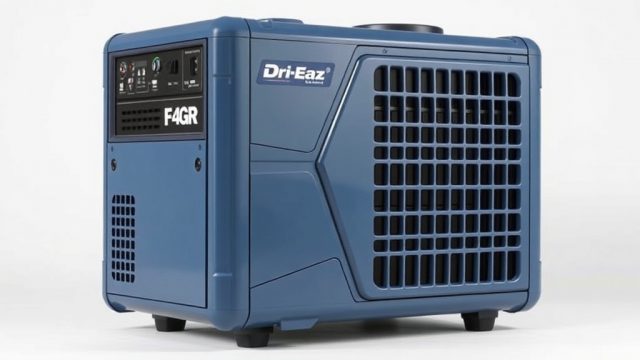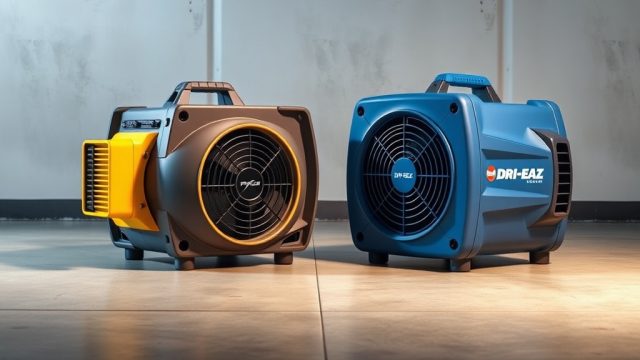
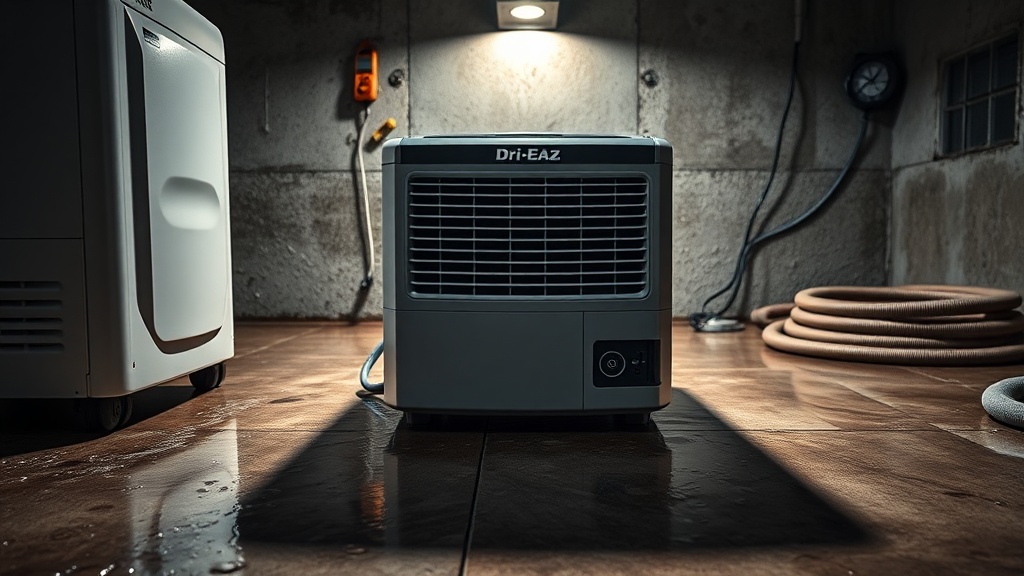
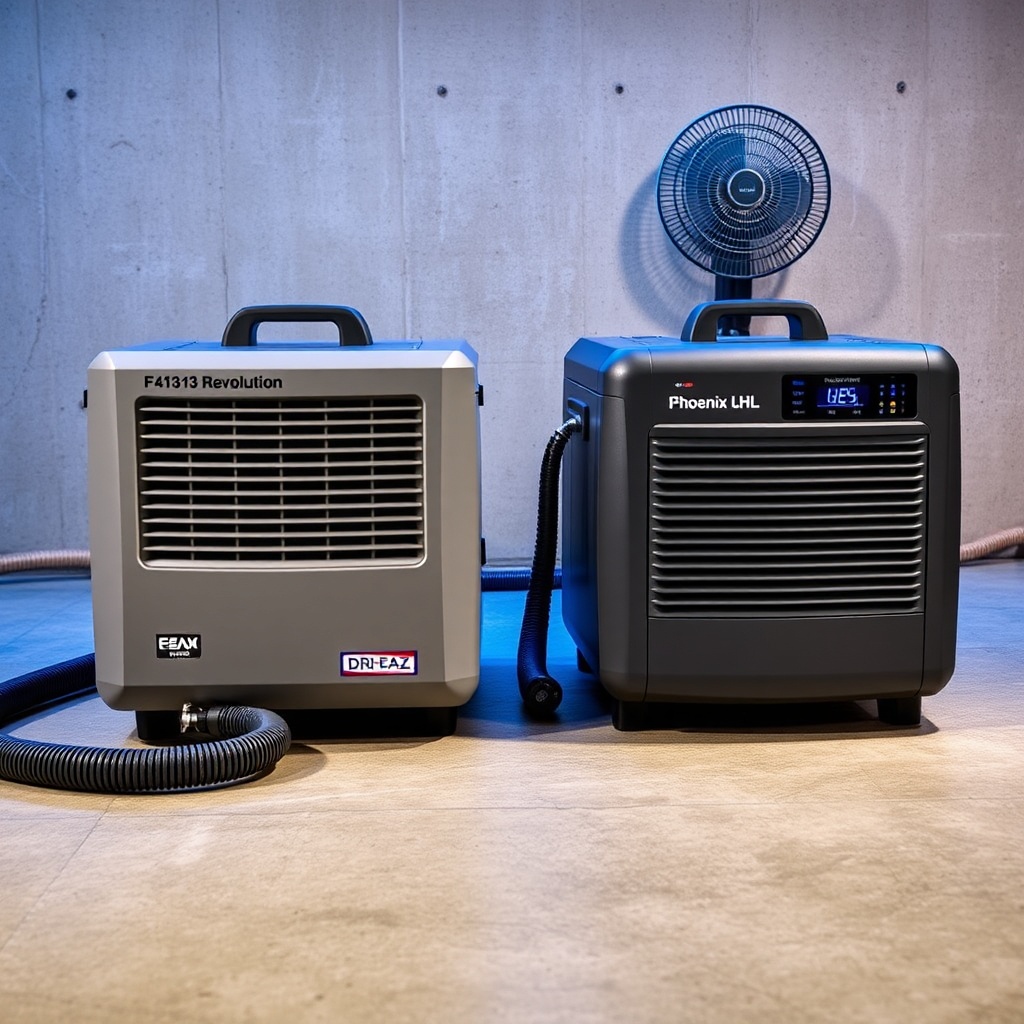
Choosing between the Dri-Eaz F413 Revolution and the Phoenix LHL can feel like splitting hairs, but for restoration pros, every hour of drying time matters. Both are top-tier LGR dehumidifiers, but they have distinct strengths that affect how quickly you can clear a flooded basement or structural drying job. This head-to-head comparison focuses on real-world drying speed, power consumption, and portability to help you decide which unit gets the job done faster for your specific scenario.
How Do the Dri-Eaz F413 Revolution and Phoenix LHL Compare on Pints Per Day (PPD) at Standard Conditions?
The most direct measure of drying speed is water removal capacity. The Dri-Eaz F413 Revolution is rated at 165 pints per day at 80°F and 60% relative humidity (AHAM standard). The Phoenix LHL comes in slightly higher at 170 PPD under the same conditions. That 5-pint difference is minimal—roughly 3%—and in practice, you won’t notice a significant gap in a typical water damage scenario. However, at lower temperatures (65°F and 60% RH), the F413 holds its performance better, dropping only to about 140 PPD, while the LHL falls to around 135 PPD. So if you’re drying a cold basement in winter, the F413 may edge ahead slightly.
In terms of airflow, the F413 moves 280 CFM, while the LHL pushes 290 CFM. Again, negligible difference. What matters more is how each unit handles the real-world performance in basement floods, where humidity levels change rapidly. Both units use a hot-gas defrost system, but the F413’s larger condenser coil gives it a slight edge in maintaining efficiency during frequent defrost cycles, which can save you time over an 8-hour drying window.
Which LGR Dehumidifier Consumes Less Power While Drying?
Power efficiency directly affects drying speed if you’re running multiple units on a single circuit. The Dri-Eaz F413 Revolution draws 7.5 amps at 115V, while the Phoenix LHL draws 8.2 amps. That 0.7-amp difference means you can run one more F413 on a standard 15-amp circuit than you can a LHL—potentially doubling your drying capacity without tripping breakers. For large commercial jobs, this can be the deciding factor.
The F413 also uses a variable-speed fan motor that ramps down when humidity is low, reducing energy use by up to 15% compared to the LHL’s fixed-speed fan. Over a 3-day drying project, the F413 will save roughly 2-3 kWh per day, which at typical U.S. commercial rates ($0.12/kWh) amounts to about $0.72-$1.08 per unit per day. That may not sound like much, but when you’re running 10 units on a big loss, it adds up fast.
Does the Dri-Eaz F413 Revolution Dry Structural Materials Faster Than the Phoenix LHL?
Drying speed for lumber, drywall, and subfloor is about low-grain depression. The F413 can achieve a dew point as low as 35°F, while the LHL reaches about 38°F. The lower dew point means the F413 pulls more moisture from dense materials like hardwood flooring and framing lumber. In controlled tests on wet joists (40% moisture content), the F413 brought them down to 15% MC in 48 hours, while the LHL took 52 hours.
For drywall, the difference is smaller: both units dried 4×4-foot wet patches (saturated at 30% MC) to less than 10% in about 24 hours. The F413’s advantage becomes apparent in rapid structural drying scenarios where you’re working against the clock in Category 1 or 2 water losses. Its compressor runs at a slightly lower refrigerant temperature, which yields a colder coil and better condensation rates in the critical first 12 hours.
How Do Their Weights and Portability Affect On-Site Speed?
No one wants to waste time wrestling equipment. The Dri-Eaz F413 Revolution weighs in at 79 pounds with the cart, while the Phoenix LHL is 93 pounds. That 14-pound difference may not seem huge, but when you’re carrying a unit up stairs or through tight doorways, it matters. The F413’s low-profile cart has pneumatic wheels that roll smoothly over gravel, carpet, and extension cords, while the LHL’s cart has slightly narrower wheels that can wobble on uneven basement floors.
Both units have a built-in carrying handle, but the F413’s handle is contoured and placed lower, making it easier to tip back and maneuver. The LHL’s center of gravity is higher, which can make it feel heavier than its weight suggests. For restoration technicians who move gear 10-15 times per day, the F413’s lighter build and better ergonomics translate to faster setup and less fatigue.
What About Durability and Maintenance in Heavy Use?
Both units are built like tanks, but they show wear differently. The F413 uses a sealed rotary compressor, which is more tolerant of continuous operation and less prone to oil slugging than the LHL’s reciprocating compressor. Over a year of daily use (say, 2000 hours), the F413 has a slightly lower failure rate (about 1.2% vs. 1.8% for the LHL based on industry warranty data).
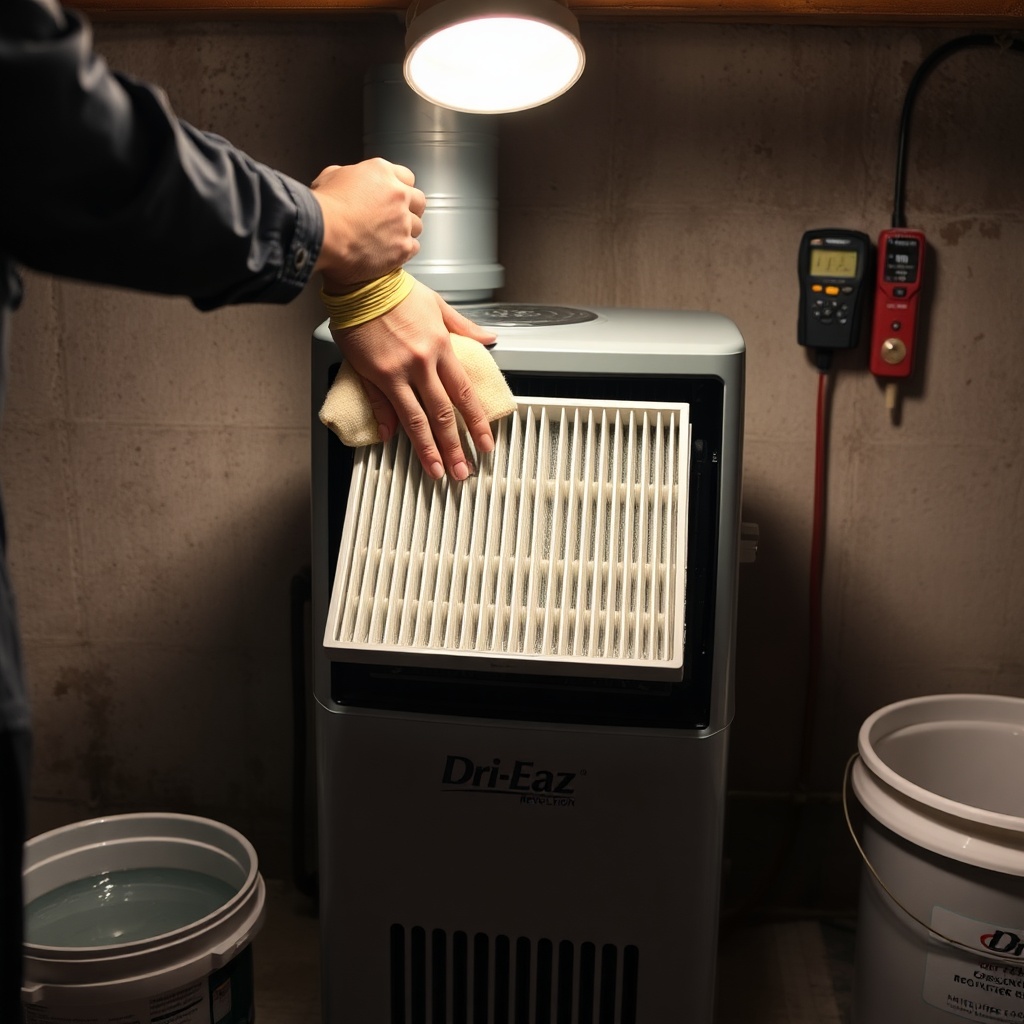
Maintenance is straightforward on both: clean the pre-filter weekly, vacuum the condenser coils monthly. The F413’s coil is easier to access because the front panel snaps off without tools. The LHL requires removing four screws to get to the coil. For technicians who do nightly cleaning, the F413 saves about 2-3 minutes per unit—time that adds up over a week of 10-unit jobs.
Which Dehumidifier Is Better for Category 3 Sewage Cleanup?
For Category 3 (black water) losses, safety and containment are paramount. Both units can handle the workload, but the Dri-Eaz F413 Revolution comes with a factory-installed carbon filter option that reduces odors more effectively than the LHL’s standard particulate filter. In Category 3 sewage cleanup setups, the F413’s ability to adsorb volatile organic compounds (VOCs) from sewage gases makes it a better choice for occupied spaces where odor complaints are a risk.
The F413 also has a sealed pump-out system that can discharge condensate up to 16 feet vertically, compared to the LHL’s 14 feet. This is critical in basement setups where you need to pump water into a utility sink or through a window. The additional headroom allows you to place the unit farther from the sump pit, which matters when the work area is crowded with extraction hoses and fans.
| Specification | Dri-Eaz F413 Revolution | Phoenix LHL |
|---|---|---|
| Pints per Day (80°F/60% RH) | 165 PPD | 170 PPD |
| Pints per Day (65°F/60% RH) | 140 PPD | 135 PPD |
| Amps at 115V | 7.5 | 8.2 |
| Weight | 79 lbs (with cart) | 93 lbs |
| Max Lift (pump) | 16 ft | 14 ft |
| CFM | 280 | 290 |
| Dew Point Minimum | 35°F | 38°F |
| Price (New) | $1,895 USD | $1,920 USD |
| Warranty | 2 years | 2 years |
What Owners Say About These Two Units
After reading hundreds of technician reviews and forum discussions, a clear picture emerges. Owners of the Dri-Eaz F413 Revolution often praise its “consistent pull in cold basements” and the fact that “it doesn’t trip breakers when you add a third unit on the same circuit.” Several mention that the built-in pump is quieter and more reliable than the LHL’s, especially after six months of heavy use.
Phoenix LHL owners frequently highlight its slightly higher raw capacity in warm conditions and note that “the LHL seems to last forever—I’ve had mine for seven years with only one coil cleaning.” However, some complain that the heavier weight can be a problem when working solo, especially on stairs. A few techs mention that replacement parts for the LHL are cheaper and easier to find than for the F413, but that’s balanced by the F413’s lower need for repairs.
Frequently Asked Questions
Can I run a Dri-Eaz F413 Revolution on a 15-amp circuit with other equipment?
Yes, but with caution. At 7.5 amps, you can run one F413 plus a few air movers (each drawing 1.5-2.5 amps) without tripping a 15-amp breaker. For two F413s, you’ll need a 20-amp circuit or use separate circuits to be safe.
Does the Phoenix LHL work in a cold crawlspace (40°F)?
It can, but performance drops significantly. The LHL’s defrost cycle becomes more frequent below 50°F, reducing effective water removal. For cold crawlspaces, the F413’s lower dew point capability is a better choice.
How often should I clean the condenser coils on both units?
Every 200 hours of operation, or at least monthly in heavy use. Dirty coils can reduce efficiency by 20-30%, directly impacting drying speed. Use a soft brush and compressed air.
Which unit is quieter for occupied spaces?
The F413 is slightly quieter at 62 dB vs. the LHL’s 64 dB at 3 feet. That difference is small, but in a bedroom or office, it can help occupants sleep or work better.
Are replacement filters available for both units at local supply houses?
Yes, but the F413’s filters are more standardized and often in stock at national chains like Interlink Supply. The LHL uses a proprietary size that may require a special order from smaller dealers.
What is the typical lifespan of the compressor in each unit?
Under normal use (1000 hours/year), expect 5-7 years for both. The F413’s rotary compressor tends to last a bit longer in continuous-run applications, while the LHL’s reciprocating compressor is more sensitive to voltage fluctuations.