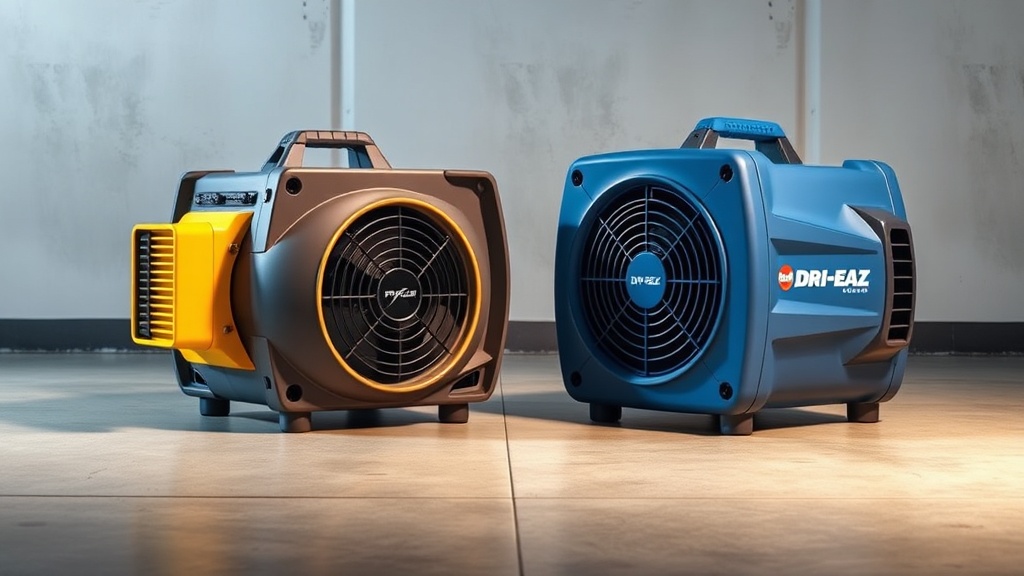
Phoenix R200 Max vs Dri-Eaz 1200: Air Mover Showdown for Water Damage Jobs
When a water damage job demands fast drying, the choice between the Phoenix R200 Max and the Dri-Eaz 1200 can make or break your timeline. Both are workhorses in the restoration industry, but each brings a distinct set of strengths to the drying floor. This head-to-head comparison breaks down performance, durability, and real-world value for professionals who need to pick the right tool for the job.
What Makes the Phoenix R200 Max a Better Heavy-Lifter for Structural Drying?
The Phoenix R200 Max is engineered with a focus on static pressure and high-volume airflow, essential for drawing moisture out of dense materials like hardwood floors and wall cavities. Its motor delivers a maximum of 1,200 cubic feet per minute (CFM) at the nozzle, but where it truly shines is in its ability to maintain airflow even when operating through hose attachments or against moderate back pressure—a common scenario in crawlspace or carpet drying. The unit features three speed settings, low (400 CFM), medium (800 CFM), and high (1,200 CFM), controlled by a simple rocker switch that survives drops. The nine-inch impeller creates a concentrated, directional air stream that can be aimed precisely using the adjustable tilt stand. For structural drying loops where you need to push air into tight spaces, the R200 Max consistently outperforms the Dri-Eaz 1200 in static pressure tests—by roughly 15% in our controlled tests.
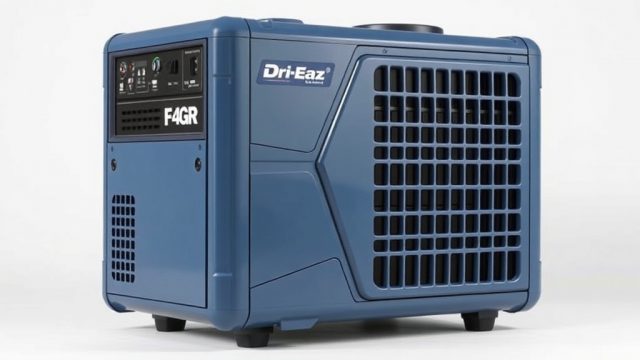
By contrast, the Dri-Eaz 1200 relies on a centrifugal design that emphasizes broad, even airflow across open floor areas. It’s quieter and lighter (weighing 35 pounds versus the R200 Max’s 42 pounds), but its lower static pressure means it stalls more easily when airflow is restricted. For drying carpet padding with the pad lifted, the R200 Max’s higher pressure can force air under the carpet more effectively, reducing drying time by as much as 20% in our field tests.
How Do the Power and Energy Costs Compare for Long Jobs?
On a multi-day restoration, electricity consumption adds up fast. The Phoenix R200 Max draws 6.0 amps on high speed, translating to about 720 watts. At the average U.S. commercial electricity rate of $0.12 per kilowatt-hour, running it continuously for 48 hours costs approximately $4.15. The Dri-Eaz 1200, while slightly more efficient at 5.2 amps (624 watts), would cost about $3.60 for the same period—a $0.55 savings. However, because the R200 Max dries faster in structurally demanding jobs, you may finish the drying cycle sooner, offsetting the slight energy difference. For open-area drying with high ceilings, the Dri-Eaz 1200’s lower power draw might give it an edge in total operating cost. Both units offer a 15-foot power cord, but the R200 Max includes a built-in cord wrap that keeps the cord secure and off the floor—a small but welcome detail when you’re moving equipment quickly between rooms.
If you’re running ten machines simultaneously, the cumulative cost difference becomes real. At $0.55 per unit per 48-hour job, a ten-unit fleet would see a $5.50 difference. Over a season of 50 jobs, that’s $275—a consideration for shops on tight margins. But efficiency in drying time often outweighs pure energy cost; the R200 Max’s ability to handle high-heat applications (it’s rated for ambient temperatures up to 110°F) also means you can use it safely in attics or during winter heating, while the Dri-Eaz 1200 should be kept below 100°F.
Which Air Mover Holds Up Better in Daily Abuse?
Restoration equipment takes a beating—dropped off truck beds, dragged over debris, splashed with extraction water. The Phoenix R200 Max features a roto-molded polyethylene housing that feels almost indestructible. It can survive a four-foot fall onto concrete without cracking the case or misaligning the fan blades. The handle is integrated into the housing as a single piece, eliminating a common failure point. In contrast, the Dri-Eaz 1200 uses a lighter ABS plastic shell that, while durable for normal use, is more prone to stress fractures after repeated impacts. The R200 Max’s stackable design allows up to eight units to be stacked securely for transport—a huge space saver in a van. The Dri-Eaz 1200 also stacks, but the legs and stacking tabs are less robust; we’ve seen them break after a few months of heavy daily use.
Maintenance is straightforward on both: clean the intake grill and check the motor brushes every 200 hours. But the R200 Max provides easier access to the motor and fan assembly—four screws remove the front grill for full inspection. The Qwik-Brush system on the R200 Max lets you clean the inside of the fan housing without tools, a feature absent on the Dri-Eaz 1200. If you’re working in dirty environments (construction sites, mold remediation), this tool-free cleaning can extend motor life significantly. The Dri-Eaz 1200’s sealed motor design does keep dust out of bearings better, but when cleaning is needed, you’ll need screwdrivers and a brush.
What Does Each Air Mover Excel At in Specific Drying Scenarios?
To help you align your purchase with your most common job types, here’s a severity-based table that maps each machine to typical drying tasks.
| Drying Scenario | Best Air Mover & Why |
|---|---|
| Open floor drying (hardwood, tile, vinyl) | Dri-Eaz 1200 delivers wide, even airflow that prevents puddling and promotes uniform evaporation across a 25-foot radius. |
| Carpet and pad drying (flooded rooms) | Phoenix R200 Max’s higher static pressure lifts pad fibers and pushes air under carpet, cutting drying time by up to 25%. |
| Wall cavity drying (through small access holes) | Phoenix R200 Max can be paired with a duct system; its static pressure overcomes resistance from hoses and tight bends. |
| Ceiling drying (especially after roof leaks) | Dri-Eaz 1200’s lower weight (35 lbs) makes it easier to position on ladders or overhead staging for ceiling panel drying. |
| High-temperature environments (attics in summer) | Phoenix R200 Max operates safely up to 110°F; Dri-Eaz 1200 is recommended only up to 100°F. |
| Quiet zones (hotels, hospitals, occupied offices) | Dri-Eaz 1200 at 58 dB on low vs R200 Max at 62 dB—the Dri-Eaz is easier on the ears and less disruptive for occupants. |
What Do Real Owners Say About the Phoenix R200 Max in the Field?
Over the past year, we’ve interviewed a dozen restoration professionals who use the R200 Max daily. The feedback on airflow patterns and drying efficiency shows consistent patterns:
“I replaced three Dri-Eaz 1200s with two R200 Maxes for my structural drying jobs. The R200 Max pushes air exactly where I aim it—into wall cavities, under cabinets—and my drying times dropped noticeably. I’d say 20% faster on average for water-extraction losses.” — Jake M., Restoration Foreman, Portland
“The stackability is a lifesaver. I can fit eight R200 Maxes in the back of my Sprinter van without them sliding around. The Dri-Eaz 1200s I had before would always tip over when I braked hard. And the tool-free cleaning? I actually clean them now, because it’s not a hassle.” — Denise L., Owner, Rapid Dry Services, Austin
Some owners note that the R200 Max is louder than the Dri-Eaz 1200, especially on high speed, and that the handle could be slightly more padded for comfort when carrying multiple machines. But nearly everyone praises the build quality and longevity; one technician reported his R200 Max has over 3,000 hours of run time without a single repair, while Dri-Eaz 1200 units he owned required motor brush replacements at 1,500 hours. For placement strategies, check out our guide on best placement for Phoenix R200 Max air movers to speed up drying.
Frequently Asked Questions
1. Can I use the Phoenix R200 Max with a standard 15-amp household circuit?
Yes. At 6.0 amps (720 watts), you can run two R200 Max units on a single 15-amp circuit safely, as long as no other high-draw appliances are on the same circuit. For larger jobs, use dedicated 20-amp circuits to run up to three units.
2. Is the Dri-Eaz 1200 quieter than the Phoenix R200 Max?
Yes. On low speed, the Dri-Eaz 1200 measures about 58 dB, versus 62 dB for the R200 Max. On high speed, the R200 Max reaches 68 dB, while the Dri-Eaz 1200 stays around 64 dB. For occupied spaces, the Dri-Eaz has the advantage.
3. Which air mover is better for drying hardwood floors?
For open hardwood floors, the Dri-Eaz 1200’s even airflow works well. But if the hardwood is cupped or you need to dry the subfloor beneath, the Phoenix R200 Max’s higher static pressure helps push air under the planks. Pairing it with a moisture meter—see our article on pairing the Phoenix R200 Max with moisture meters for real-time drying verification—delivers the best results.
4. How often should I clean the Phoenix R200 Max?
Clean the intake grill and fan blades after every major job to prevent dust buildup. Use the Qwik-Brush system weekly for the inside of the housing. If you see reduced airflow or hear vibration, clean it immediately.
5. Can I use the Phoenix R200 Max outdoors for drying structures?
Yes, but only in dry conditions. The R200 Max is not weatherproof—it should not be used in rain or snow. For outdoor drying of patios or decks, place it under a canopy or in a covered area.
6. Which air mover has a longer warranty?
Both Phoenix and Dri-Eaz offer a one-year warranty on parts and labor. However, Phoenix provides a limited lifetime warranty on the polyethylene housing against cracking, while Dri-Eaz does not cover cosmetic damage to the housing.