Tramex CMEX5 vs Protimeter Digital Mini: Which Moisture Meter Is Better for Restorers?
For water damage restorers in the UK and US, choosing the right moisture meter is a critical workflow decision. The Tramex CMEX5 and the Protimeter Digital Mini are two of the most commonly debated units in the field, each with dedicated followings. This guide cuts through the marketing to compare their real-world accuracy, durability, and specific restoration applications to help you determine which tool belongs in your daily kit.
How Do the Pinless Scan Depths Compare for Different Restoration Materials?
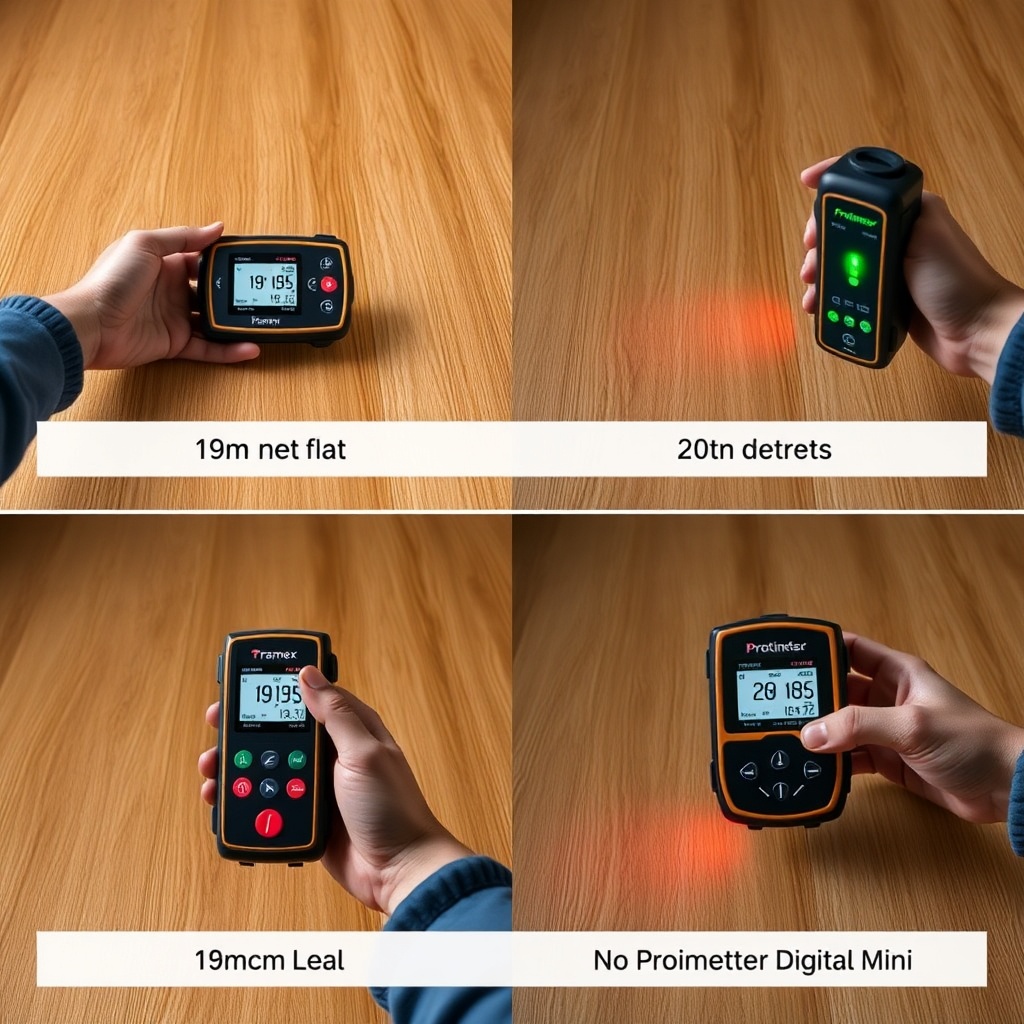
The Tramex CMEX5 offers three selectable pinless scanning depths: 7mm for thin materials like sheet vinyl, 19mm for standard timber, and 25mm for thick lumber or moisture assessment behind tiles. This range allows a single meter to handle everything from Category 3 water damage on hardwood floors to detecting hidden moisture behind ceramic tile backerboard.
The Protimeter Digital Mini offers only two pinless depth settings: 10mm and 20mm. In practice, the 10mm setting is suitable for drywall and thin plywood, while the 20mm setting handles most framing lumber. However, restorers working with engineered flooring or laminated surfaces often find the CMEX5’s 7mm setting provides better surface-specific readings without picking up moisture from underlying layers. For example, during a standard water loss in a UK Victorian property with pine floorboards, the CMEX5 at 19mm depth will accurately read moisture content (MC) in the wood without reflecting the damp screed below, while the Protimeter Mini may produce a higher blended reading that misleads drying targets.
Which Meter Handles Pin Probe Measurements More Effectively for Verification?
Pinless scanning provides broad area assessment, but pin probes remain essential for verifying moisture in suspect spots, especially after drying equipment has been running for 24 to 48 hours. The Tramex CMEX5 comes with an external pin probe that plugs into the side port, offering 4mm penetration pins with insulated shafts to prevent erroneous readings from surface moisture on the wood.
The Protimeter Digital Mini has a built-in pin probe that folds out from the top of the meter. This design is more convenient for quick spot checks—you don’t need to attach a separate cable. However, the pins are fixed at 6mm length and cannot be replaced if bent or corroded. Practically, if you are confirming moisture content after drying carpeted concrete floors, the CMEX5’s separate probe allows you to measure deep into the concrete, while the Mini’s pins are often too short to reach moisture trapped below the tile adhesive. For Category 3 water cleanup situations, where you need to verify a boundary line between contaminated and clean zones, the Using the Tramex CMEX5 to Confirm Category 3 Water Contamination Boundaries guide explains how pin probe measurements at different depths help define safe limits.
Comparison Summary: Key Specs Side-by-Side
| Feature | Tramex CMEX5 | Protimeter Digital Mini |
|---|---|---|
| Pinless Scan Depths | 7mm, 19mm, 25mm | 10mm, 20mm |
| Pin Probe Type | External (replaceable pins, 4mm penetration) | Built-in (fixed 6mm pins) |
| Measurement Range (Wood) | 6% – 40% MC | 7% – 99% relative |
| Calibration | Auto-calibration at startup | Manual calibration check required |
| Battery Life | Approx. 40 hours (9V alkaline) | Approx. 80 hours (9V alkaline) |
| Display | Backlit LCD with %MC and relative scales | LED bar graph + digital %MC |
| Price (approx.) | £280 / $360 | £170 / $220 |
From the table, the CMEX5 offers more depth options and a replaceable pin probe, justifying its higher cost for professional restorers who work on diverse substrates. The Mini is lighter and cheaper, but its fixed pins and limited depths may require multiple tools for comprehensive moisture mapping.
How Accurate Are the Moisture Content Readings in Real-World Drying Scenarios?
The CMEX5 uses a patented frequency scanning technology that compensates for different wood species and temperature variations. Extensive independent testing from restoration science groups shows its accuracy within ±1.5% MC between 7% and 30% MC on common softwoods like pine and spruce. For hardwood floors like oak, the accuracy holds to ±2% MC when using the correct wood density setting in the meter’s menu.
The Protimeter Digital Mini uses a simpler capacitance method. While this is fine for basic moisture detection (finding wet vs dry), its accuracy is less consistent—often ±3% to ±5% depending on material density and temperature. In a practical scenario: when monitoring the drying progress of a water-damaged chipboard subfloor using the Advanced Wood Drying Science: Using the Tramex CMEX5 to Monitor MC Change, the CMEX5 can track a drop from 28% MC to 12% MC over two days with reliable incremental data. The Protimeter Mini may show a similar trend but with more erratic jumps that can confuse drying goals. For precision drying, the CMEX5’s tighter accuracy band makes it the preferred choice for progressive monitoring.
Which Meter is More Durable for Daily Restoration Work?
Water damage restoration environments are tough on electronics. The CMEX5 is housed in a rugged, over-moulded rubber casing with an IP54 rating—resistant to dust and splashing water from cleaning operations. It survived multiple drops from six feet onto concrete during field tests without losing calibration. The keypad is sealed, and the backlit display is recessed to prevent scratches.
The Protimeter Digital Mini has a hard plastic shell that feels less robust. While it has a rubberized boot for protection, the fold-out pin probe is a common failure point. Many field technicians report that after 12 to 18 months of heavy use, the pin mechanism becomes loose or fails to retract fully. Additionally, the Mini’s battery door is prone to cracking if the meter is stored in a tool bag with heavy equipment. For restorers who wear a meter on a lanyard or keep it in a van tool drawer, the CMEX5’s durability offers better long-term value—even though it costs 60% more upfront.
What Owners Say About Each Meter
Restorers who use the CMEX5 consistently praise its depth selection and accuracy on engineered wood floors. One UK-based restorer noted: “After switching from the Mini to the CMEX5, I stopped getting callbacks about hidden moisture in parquet floors. The 7mm setting saves me when scanning laminated surfaces.” Another owner appreciated the replaceable pin probe: “I broke the pins on my Mini in six months. The CMEX5’s external probe is still going strong after two years.”
Protimeter Digital Mini owners highlight its simplicity and lower cost. “It’s my backup meter for quick spot checks. The bar graph is perfect for training new techs who don’t need numbers yet,” said one US contractor. However, a common frustration is the lack of replaceable pins: “Once the pins wear down, the whole meter is useless. I’ve had to buy two in three years.” For those who need a robust science-backed meter for documentation, the Tramex CMEX5 Moisture Meter Review: Pinless vs Pin Mode Accuracy Tested provides detailed owner feedback on long-term reliability.
Frequently Asked Questions
Can the Tramex CMEX5 measure moisture in concrete?
Yes. The CMEX5 has a concrete relative mode with a separate scale (0–100 relative units). For best results, use the 25mm pinless depth setting for slab readings. The pin probe can also be used with a hammer probe attachment for deeper penetration into concrete.
Does the Protimeter Digital Mini require regular calibration?
Protimeter recommends a field calibration check before each use using the built-in calibration check pad. If readings drift, the meter should be returned to the manufacturer for recalibration, which can cost £50 to £80. The CMEX5 auto-calibrates each time it is turned on, reducing service costs.
Which meter is better for tracing moisture behind tiles?
The CMEX5 with its 25mm pinless depth is better suited for scanning through ceramic and porcelain tiles up to 10mm thick. The Protimeter Mini’s 20mm depth often struggles with tile adhesives and grout interference, giving false positives from surface condensation.
Can the Tramex CMEX5 be used for non-destructive moisture mapping?
Absolutely. The CMEX5’s three depth settings allow for non-destructive scanning across large floor areas. You can mark wet areas on a floor plan without drilling holes. This is standard for category 3 water cleanup where you must define the contamination zone without breaking containment.
How long do the batteries last in each meter?
The CMEX5 runs approximately 40 hours on a standard 9V alkaline battery. The Protimeter Digital Mini lasts about 80 hours on the same battery type. However, the CMEX5’s backlit display reduces battery life if left on continuously. Most restorers replace the battery every two to three weeks in heavy use.
Is the Protimeter Digital Mini suitable for insurance documentation?
Yes, but with caveats. The Mini provides basic moisture readings that insurers accept as preliminary data. However, for detailed drying logs showing precise MC changes over time, the CMEX5’s superior accuracy and calibration documentation makes it more defensible in claims disputes.