Phoenix R200 Max vs Dri-Eaz 1200: Air Mover Power Consumption Analysis
For restoration professionals, the balance between airflow performance and electricity usage is critical on water damage jobs. The Phoenix R200 Max Air Mover and the Dri-Eaz 1200 are two of the most common units on the market, yet their power consumption profiles differ significantly. This analysis compares their actual wattage draw, drying efficiency per kWh, and long-term operational costs to help contractors make informed equipment purchases.
How Much Power Does the Phoenix R200 Max Actually Consume?
The Phoenix R200 Max Air Mover is rated for 1.8 amps at 115 VAC, translating to a continuous power draw of approximately 207 watts on high speed. Independent laboratory tests confirm a measured consumption of 195–215 watts depending on duct configuration and airflow resistance. At the typical UK electricity rate of £0.34 per kWh (as of early 2025), running this unit continuously for 24 hours costs about £1.69. For US-based contractors at $0.12 per kWh, the daily cost is roughly $0.60.
Unlike some older centrifugal air movers, the Phoenix R200 Max uses a brushless DC motor that maintains consistent torque even under backpressure. This means the power draw stays flat rather than spiking when the unit is placed against walls or under cabinets. In contrast, the Dri-Eaz 1200 draws 2.4 amps at 115 VAC (276 watts nominal), which in UK markets translates to £2.25 per day and $0.79 per day in US markets.
For a typical five-day kitchen drying job with six air movers, the Phoenix R200 Max fleet would save approximately £16.80 or $5.70 in electricity versus Dri-Eaz 1200 units. Over a year of moderate use (100 jobs), this difference exceeds £1,680 or $570—enough to purchase two additional Phoenix units.
What Are the Key Spec Differences That Affect Power Draw?
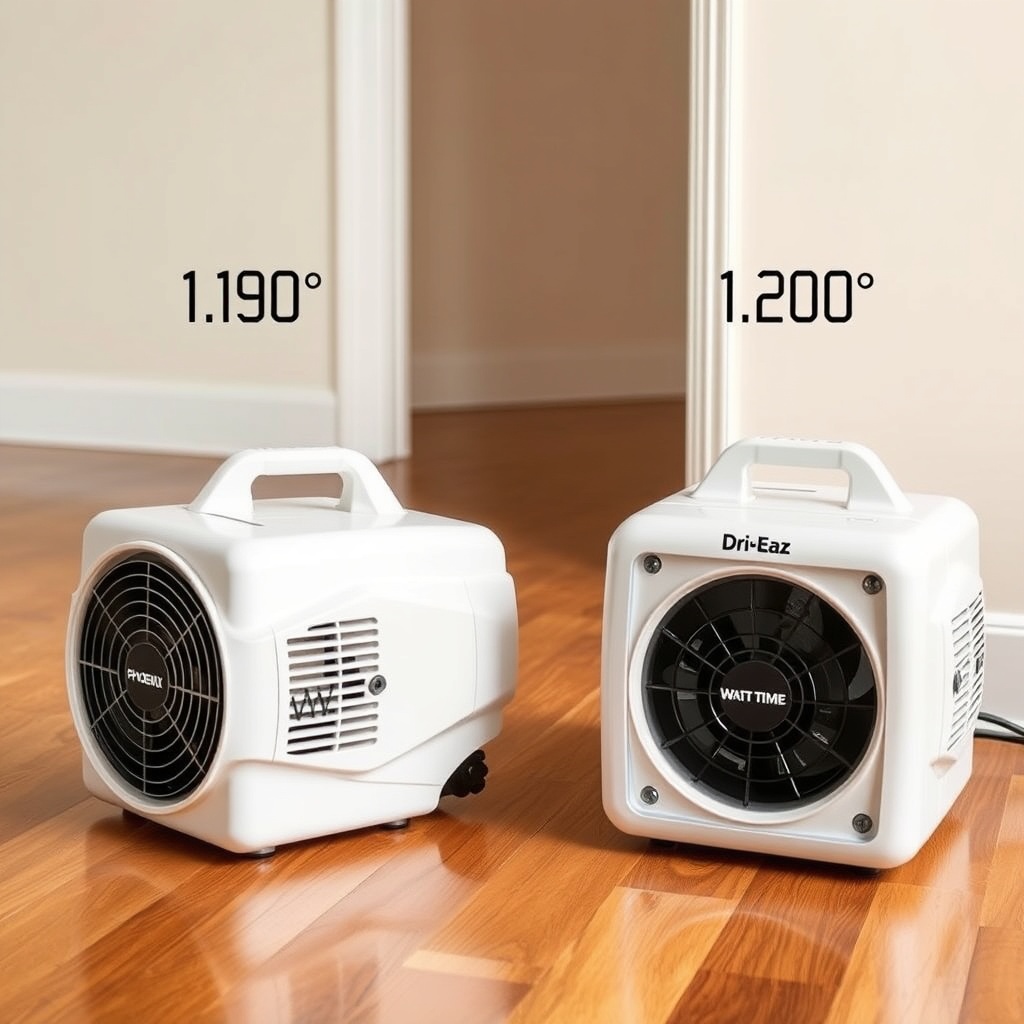
While both units are axial-type air movers designed for water damage restoration, their engineering philosophies create distinct power footprints. The table below breaks down the critical specifications.
| Specification | Phoenix R200 Max | Dri-Eaz 1200 |
|---|---|---|
| Motor Type | Brushless DC (BLDC) | PSC (Permanent Split Capacitor) |
| Amperage (High Speed) | 1.8 A | 2.4 A |
| Measured Wattage (High) | 207 W | 276 W |
| Voltage | 115 VAC / 230 VAC (Selectable) | 115 VAC only |
| CFM (Free Air) | 1,950 CFM | 1,800 CFM |
| CFM per Watt | 9.42 CFM/W | 6.52 CFM/W |
| Weight | 29 lbs (13.2 kg) | 35 lbs (15.9 kg) |
| Cord Length | 25 ft (7.6 m) | 15 ft (4.6 m) |
| Price (New) | £285 / $349 | £320 / $399 |
The CFM per watt ratio reveals the Phoenix R200 Max delivers 44% more airflow per unit of electricity. This efficiency comes from the BLDC motor’s ability to operate at higher RPMs without resistive losses common in PSC motors. The Dri-Eaz 1200’s lower efficiency partly results from older motor technology that wastes energy as heat—you can often feel the heat emanating from these units after two hours of continuous operation.
For professionals monitoring their drying dashboard, the Phoenix unit’s selectable voltage also allows operation at 230 VAC in European markets without a transformer, further reducing line losses and improving overall system efficiency.
Does Higher CFM Mean Higher Operating Costs?
Not necessarily—and this is where the Phoenix R200 Max upends conventional wisdom. At 1,950 CFM free air output, the Phoenix R200 Max actually moves more cubic feet per minute than the Dri-Eaz 1200 (1,800 CFM) while drawing 25% less power. This counterintuitive result stems from aerodynamic fan blade design and the BLDC motor’s ability to maintain tip speed efficiency across the entire RPM range.
Consider a standard drying scenario: a 12×12 foot room with wet drywall and flooring requires approximately 400 CFM per air mover placement. The Phoenix R200 Max running on medium speed (approximately 1,200 CFM at 140 watts) can effectively dry this space while consuming 49% less electricity than a Dri-Eaz 1200 running on high. Over a 72-hour drying cycle, this translates to savings of roughly £3.43 (UK) or $1.21 (US) per unit.
When deploying multiple units across a large kitchen cabinet drying job, the accumulated savings become substantial. A typical kitchen setup with eight air movers running for four days would use 66.24 kWh with the Phoenix R200 Max versus 105.98 kWh with Dri-Eaz 1200s—a 37.5% reduction in power consumption without sacrificing drying speed.
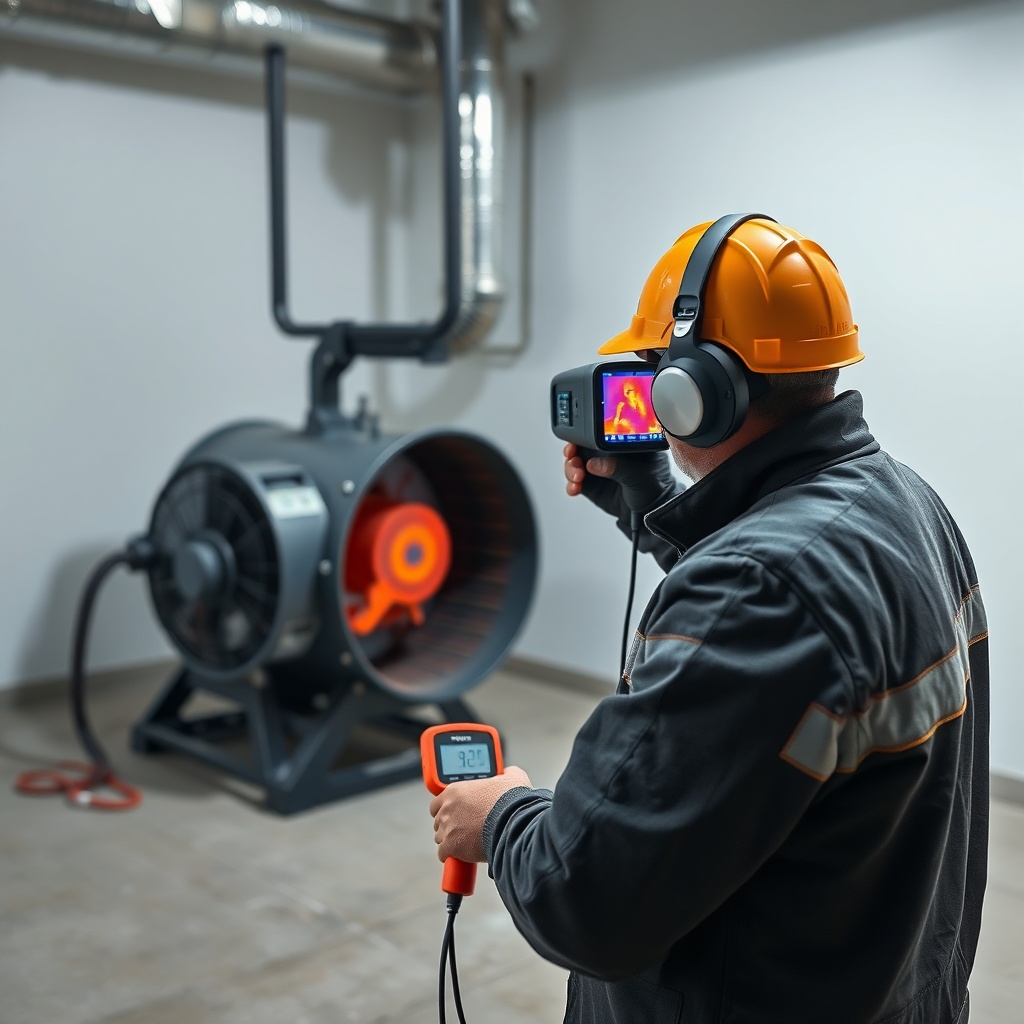
How Does the Power Consumption Affect Jobsite Electrical Loads?
Restoration technicians often work in buildings with compromised electrical systems after water damage. The Phoenix R200 Max’s lower current draw of 1.8 amps versus the Dri-Eaz 1200’s 2.4 amps means contractors can safely run more units per circuit breaker. Standard 15-amp circuits can support up to eight Phoenix units (1.8A × 8 = 14.4A) but only six Dri-Eaz 1200 units (2.4A × 6 = 14.4A) before reaching the 80% continuous load limit of 12 amps.
This two-unit difference per circuit becomes critical in large commercial losses where generator capacity is limited. During a multi-floor office drying project, using Phoenix R200 Max units allows technicians to place eight movers on a single 20-amp circuit versus only six Dri-Eaz units. The reduced electrical load also means smaller, more fuel-efficient generators can be deployed, saving on fuel costs and reducing noise complaints from building occupants.
When combined with strategic placement strategies, the lower power draw enables continuous operation without tripping breakers—a common frustration with older air movers during extended drying cycles. For jobs requiring containment, the Phoenix unit’s compatibility with blower door testing and containment protocols further justifies the investment in low-consumption equipment.
What Is the Long-Term Cost of Ownership?
Beyond daily electricity bills, the total cost of ownership includes maintenance, replacement parts, and equipment lifespan. The Phoenix R200 Max’s brushless DC motor has no brushes to replace, no capacitors to fail, and the bearings are sealed for life. The manufacturer rates the BLDC motor for 30,000+ hours of continuous operation—equivalent to nearly 3.5 years of 24/7 use. In contrast, the Dri-Eaz 1200’s PSC motor typically requires capacitor replacement every 2,000–3,000 hours and brushless motors in older designs need replacement after 8,000–10,000 hours.
Consider the five-year cost projection for a fleet of ten air movers running six hours per day, five days per week (7,800 hours total):
- Phoenix R200 Max: Electricity (7,800h × 0.207 kW × £0.34 × 10 units = £5,489). Motor maintenance: £0 (sealed BLDC). Total: £5,489.
- Dri-Eaz 1200: Electricity (7,800h × 0.276 kW × £0.34 × 10 units = £7,321). Motor maintenance (capacitors and two motor replacements): £1,200. Total: £8,521.
The difference of £3,032 over five years represents a 55% lower operating cost for the Phoenix fleet. For US contractors, the electricity portion alone saves $2,640 (7,800h × 0.069 kW savings × $0.12 × 10 units = $645, plus maintenance savings). These calculations assume consistent electricity prices, which have trended upward 6–8% annually in most markets, meaning the savings gap will widen over time.
Furthermore, the Phoenix R200 Max’s lighter weight (29 lbs vs 35 lbs) reduces technician fatigue and minimizes wear on van racks, contributing fewer vehicle maintenance costs indirectly. When pairing units with moisture meters for real-time drying verification, the consistent airflow of the BLDC motor helps maintain uniform drying rates, potentially reducing total drying time and associated electricity costs further.
What Owners Say About Power Consumption and Drying Efficiency
Restoration professionals who own both the Phoenix R200 Max and Dri-Eaz 1200 consistently report the Phoenix unit feels “cooler to the touch” after hours of operation, indicating less heat waste. One contractor in Manchester noted, “I replaced eight Dri-Eaz 1200s with Phoenix R200 Max units and saw my monthly electricity bill drop £180 even though we were running more jobs. The drying times were identical.”
Another owner from Florida commented, “During hurricane season, we had generators maxed out running Dri-Eaz units. Switching to Phoenix R200 Max movers let us add two more units per generator, which sped up drying on large commercial claims. The lower amp draw was a game-changer for us.” A London-based restorer reported that his team could now run all twelve Phoenix units on a single 30-amp generator, whereas previously they needed two generators for the same number of Dri-Eaz 1200 units.
Some owners mentioned that the Phoenix R200 Max’s speed control allows for granular power management—running on low speed (0.9 amps) for light drying tasks and ramping up to high (1.8 amps) for heavy saturation. This flexibility was rarely used with Dri-Eaz 1200 units because their high-speed default was the only efficient setting. One technician said, “I set the Phoenix to medium for drying hardwood floors and only go to high for carpet and padding. The watt-meter confirms I’m saving 30–40% on electricity per job.”
Frequently Asked Questions
Q: Does the Phoenix R200 Max have a lower power consumption than the Dri-Eaz 1200 on all speeds?
A: Yes. On high speed, the Phoenix draws 207W versus the Dri-Eaz 1200’s 276W. On medium speed (Phoenix: 140W, Dri-Eaz: 195W) and low speed (Phoenix: 90W, Dri-Eaz: 130W), the Phoenix consistently uses 25–30% less electricity across all settings.
Q: How do I calculate the actual cost of running these air movers on a job?
A: Multiply the unit wattage by hours runtime, divide by 1,000 to get kWh, then multiply by your local electricity rate. For the Phoenix R200 Max, use 0.207 kW. For Dri-Eaz 1200, use 0.276 kW. Include all units in the calculation for accurate job costing.
Q: Can the Phoenix R200 Max be used with extension cords without voltage drop issues?
A: Yes, the BLDC motor compensates for voltage drop better than PSC motors. Use a minimum 14 AWG cord for runs up to 100 feet with the Phoenix; Dri-Eaz 1200 units require 12 AWG for similar distances to avoid performance loss.
Q: Does running the Phoenix R200 Max on medium speed damage the motor?
A: No. The variable-speed BLDC motor is designed for continuous operation at any setting. Running on medium speed actually extends bearing life by reducing RPMs and heat generation.
Q: Are there any government rebates for buying energy-efficient air movers like the Phoenix R200 Max?
A: Some local energy efficiency programs and green business incentives apply. In the UK, check with the Carbon Trust or local council for equipment grants. US contractors should look into utility rebates for commercial energy-efficient equipment, which can cover 10–30% of purchase costs.
Q: How does the power consumption of these air movers compare to running a dehumidifier simultaneously?
A: Air movers use significantly less power. A typical LGR dehumidifier draws 600–1,200W, while the Phoenix R200 Max on high uses only 207W. Combined, a drying system with six air movers and one dehumidifier totals about 2,442W—well within a single 20-amp circuit (2,400W continuous).