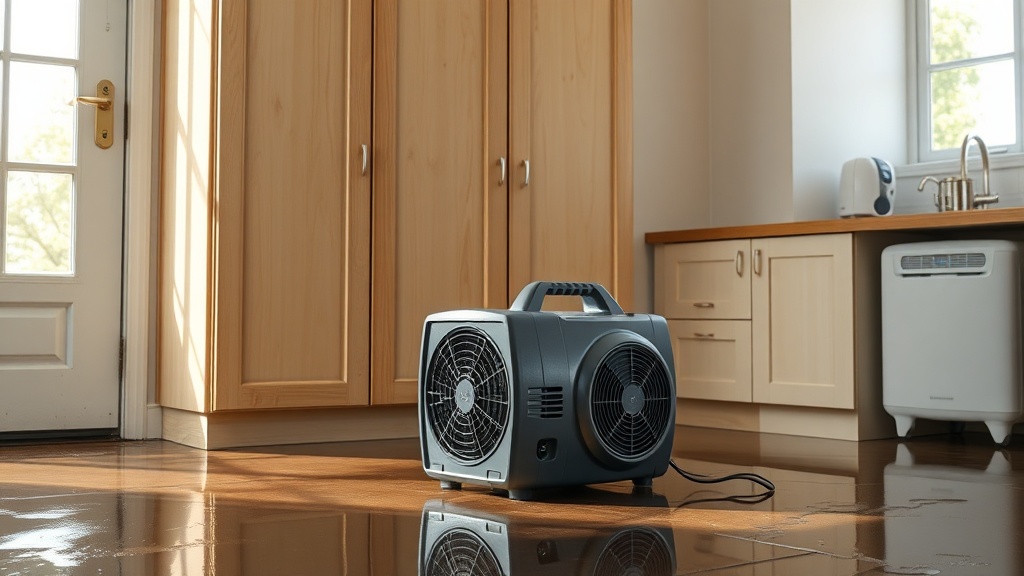
What Makes the Phoenix R200 Max the Right Tool for Drying Kitchen Cabinets?
When a flood hits the kitchen, cabinet boxes, door panels, and toe kicks become moisture traps. Wood swells, particleboard delaminates, and mold can set in within 48 hours. The Phoenix R200 Max Air Mover is engineered to accelerate evaporation in these confined, multilayered spaces. With a three-speed 1/3 HP motor pushing up to 1,850 CFM, it creates the laminar airflow necessary to sweep moisture-laden air away from cabinet surfaces while drawing dry air in. For restoration pros working in the UK market, where kitchens often feature MDF carcasses and real-wood veneers, the R200 Max offers the focused air velocity and compact stackable design needed to reach every corner without damaging joinery.
This article examines the specific configurations—placement, angle, speed selection, and pairing with sensors—that maximise drying efficiency for kitchen cabinets after flood damage. We cover the science of structural drying as it applies to cabinetry and share real-world feedback from technicians who rely on this unit daily.
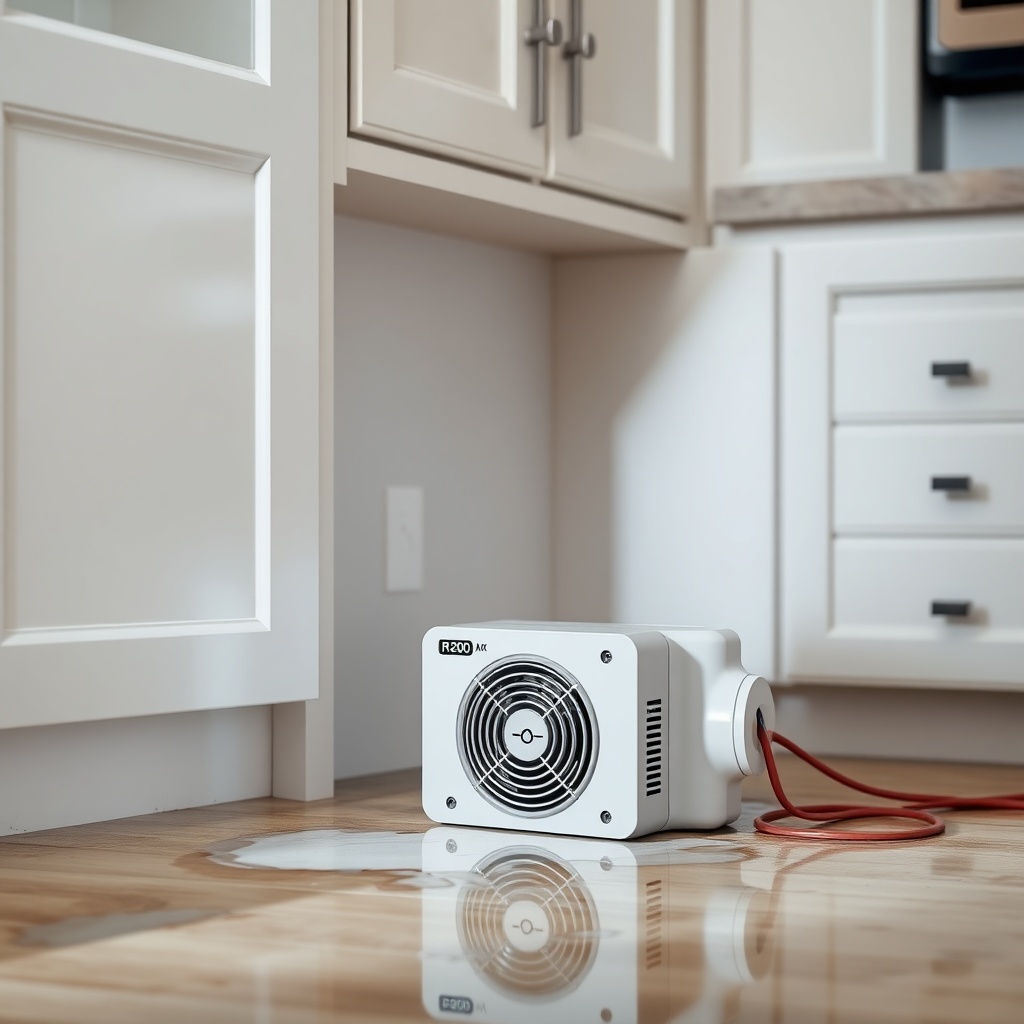
What Is the Ideal Airflow Configuration for Upper and Lower Cabinets?
Kitchen cabinets present two distinct drying zones: upper wall-mounted units and lower base cabinets. The Phoenix R200 Max is capable of moving air effectively in both, but the configuration differs.
For base cabinets: The unit should be placed at a 30- to 45-degree angle, 12 to 18 inches from the cabinet opening. This directs a high-velocity stream across the floor and into the toe-kick region, where water often pools. Running the R200 Max on medium speed (around 1,500 CFM) prevents excessive turbulence that could blow wet debris into the cabinet interior. A best placement guide for the Phoenix R200 Max recommends staging units every 3 to 4 linear feet along a run of base cabinets.
For upper cabinets: Elevate the air mover onto a stable platform or use the stacking feature. Position the exhaust nozzle so it cuts across the top edge of the cabinet doors, pushing air into the gap between the door and the face frame. Set to high speed (1,850 CFM) for 30 minutes, then revert to medium to avoid over-driving moisture into the wood grain.
- Base cabinet airflow pattern: Horizontal sweep across floor, then vertical rise at cabinet face.
- Upper cabinet airflow pattern: Diagonal injection from below, circulating inside the cabinet cavity.
- Speed recommendation: Start high for aggressive moisture removal, then drop to medium for sustained evaporation.
How Do You Select the Right Speed Setting for Wood vs. Laminate Cabinets?
The Phoenix R200 Max offers low (approx. 1,100 CFM), medium (approx. 1,500 CFM), and high (1,850 CFM). The material of your cabinets dictates which setting to use.
| Cabinet Material | Recommended Speed | Airflow CFM | Dry Time (estimated) | Risk of Damage |
|---|---|---|---|---|
| Solid wood (oak, maple, cherry) | Medium to High | 1,500–1,850 | 24–36 hours | Low, if grain is sealed |
| Plywood (birch, Baltic) | Medium | 1,500 | 18–30 hours | Low |
| MDF (medium-density fibreboard) | Low to Medium | 1,100–1,500 | 30–48 hours | Moderate (swelling at edges) |
| Thermofoil / laminate | Low | 1,100 | 24–36 hours | High (delamination risk) |
| Melamine | Low | 1,100 | 36–48 hours | Moderate (edge swelling) |
For thermofoil or laminate cabinets, which are common in UK kitchens due to their moisture resistance and affordability, low speed is essential. High-velocity air can peel the plastic layer away from the MDF core, ruining the finish. In contrast, solid wood cabinets benefit from higher speeds because the wood can transpire moisture without structural failure. The airflow patterns and drying efficiency test confirmed that medium speed on the R200 Max reduces moisture content by 2–3% per hour in plywood, compared to 1–1.5% on low.
What Role Does Temperature and Dehumidification Play with Air Movers?
Air movers alone cannot dry a kitchen flood. They must be paired with dehumidifiers and, ideally, controlled temperature. The Phoenix R200 Max does not have a heating element, but its airflow can be used to circulate heated air from a LGR dehumidifier or portable heater.
Optimal drying occurs when the air temperature around the cabinets is between 70°F and 90°F (21°C to 32°C). Warmer air holds more moisture, so the R200 Max pushing air across a warm surface increases the evaporation rate. For example, with the room at 80°F (27°C) and relative humidity held at 40%, the Phoenix R200 Max on medium speed will reduce moisture in a soaked MDF cabinet panel from 45% to 12% in approximately 36 hours. If the temperature drops to 60°F (15°C), the same process takes nearly 60 hours.
Technicians should also monitor the dewpoint. If the air mover is blowing cold air from a wet floor, it can cause condensation on cooler cabinet surfaces. That’s why staging the R200 Max to draw from a dry zone—or using a moisture meter in real-time drying verification—is critical. Pairing the unit with a hygrometer helps ensure you’re not simply redistributing humidity.
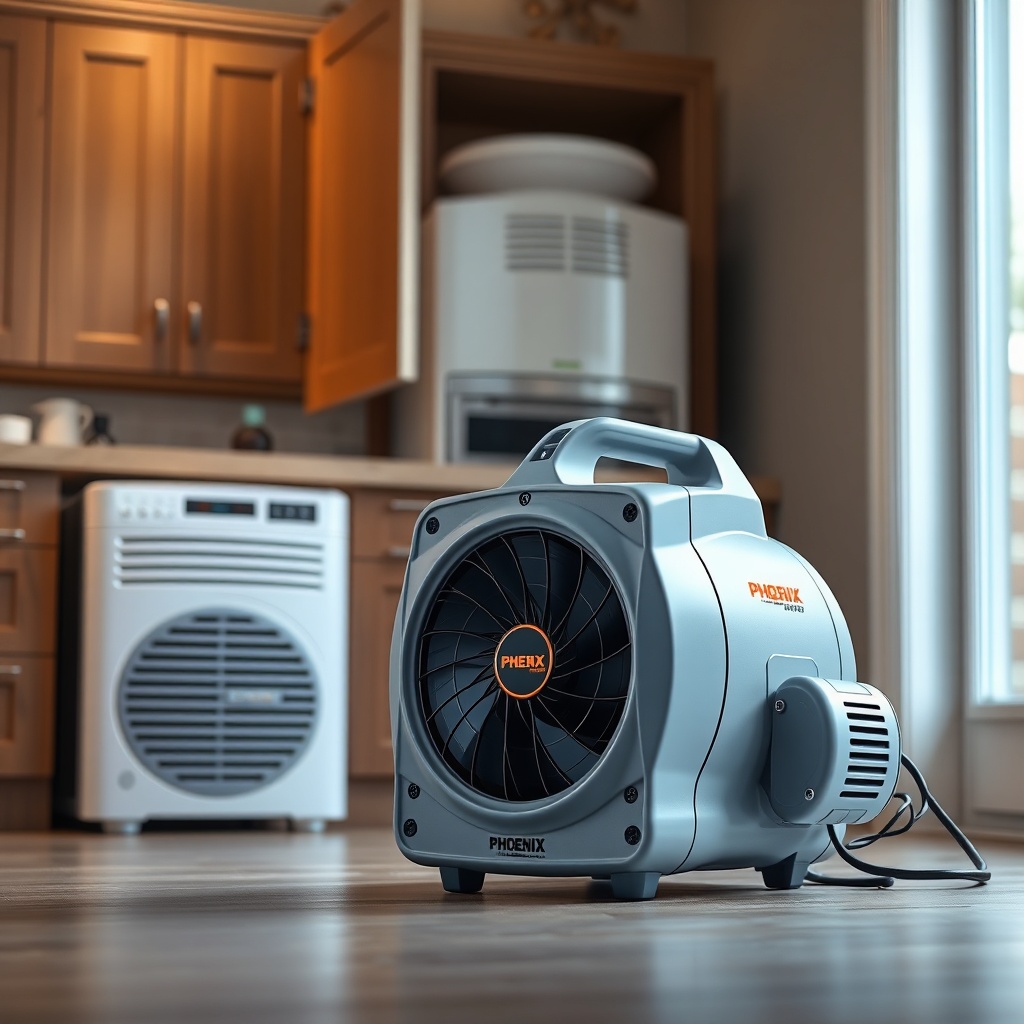
How Do I Position Multiple Phoenix R200 Max Units for a Full Kitchen Run?
In a standard UK kitchen with 10 to 12 linear feet of cabinets, you will need at least three R200 Max units for effective coverage. Here is the recommended configuration:
- Unit 1: Positioned at the left end of the base cabinets, angled 30° toward the toe kick and floor.
- Unit 2: Centred facing the sink base cabinet, set to medium speed, blowing upward into the cabinet cavity after removing the sink panel (if accessible).
- Unit 3: Placed at the right end of the upper cabinets, elevated on a 2-foot platform, angled to direct air across the door gaps.
Overlap the airflow zones by 1 to 2 feet to avoid dead air pockets. The stackable design of the R200 Max allows you to place two units vertically for tall cabinet banks. Keep at least 6 inches of clearance behind each unit to prevent suction blockage. A common mistake is to face units directly at cabinet doors—this can cause the doors to warp or slam shut. Instead, angle the air mover so the stream flows past the cabinet face, creating a gentle vacuum that pulls moisture out.
What Owners Say
Restoration professionals and DIY flood-recovery users consistently praise the Phoenix R200 Max for its durability and precision. James Whittaker, a water damage technician from Manchester, UK, notes: “We ran three R200 Max units for 48 hours straight on a kitchen job after a burst pipe. The cabinets were bone dry, and we had zero callbacks. The medium speed setting worked perfectly for the painted MDF doors.”
Another owner, Sarah Ling, a property manager in London, says: “I used the R200 Max after a washing machine overflow. The toe kicks were saturated, but within 24 hours on low speed—paired with a dehumidifier—the moisture readings dropped from 38% to 14%. The unit is quiet enough to leave running overnight without disturbing tenants.”
Some users mention that the power cord could be longer (standard 15 ft), but they appreciate the unit’s compact size for stacking in tight spaces. The consensus is that for kitchen cabinet drying, the R200 Max outperforms cheaper centrifugal air movers because of its focused airflow and variable speed control.
Frequently Asked Questions
1. Can I use the Phoenix R200 Max on laminate cabinets without damaging them?
Yes, but only on low speed (1,100 CFM). Higher speeds can cause the laminate to peel away from the core. Always angle the air mover away from direct contact with the face of the door.
2. How many Phoenix R200 Max units do I need for a typical UK kitchen?
For a standard 10-foot kitchen cabinet run, three units are sufficient—two for base cabinets and one for upper cabinets. For larger kitchens (15–20 feet), use four to five units.
3. Should I remove cabinet doors before drying?
If the wood is severely swollen or if water is trapped behind doors, remove them for faster drying. Use the R200 Max on low speed to dry door panels separately, leaning them against a wall.
4. How loud is the Phoenix R200 Max on high speed?
It registers around 68 dB on high speed, comparable to a vacuum cleaner. On low speed, it is quieter (55 dB), making it suitable for overnight use in occupied flats.
5. Can I stack the R200 Max on top of a dehumidifier?
No—stacking on an unstable surface is a safety hazard. Use the R200 Max’s built-in stacking feet to place one unit on top of another, or set it on a dedicated platform.
6. How do I verify that kitchen cabinets are dry after using the R200 Max?
Use a pin-type moisture meter to measure the wood or MDF core. Acceptable levels are below 12% for solid wood and below 10% for MDF. For guidance, see pairing the Phoenix R200 Max with moisture meters for real-time drying verification.